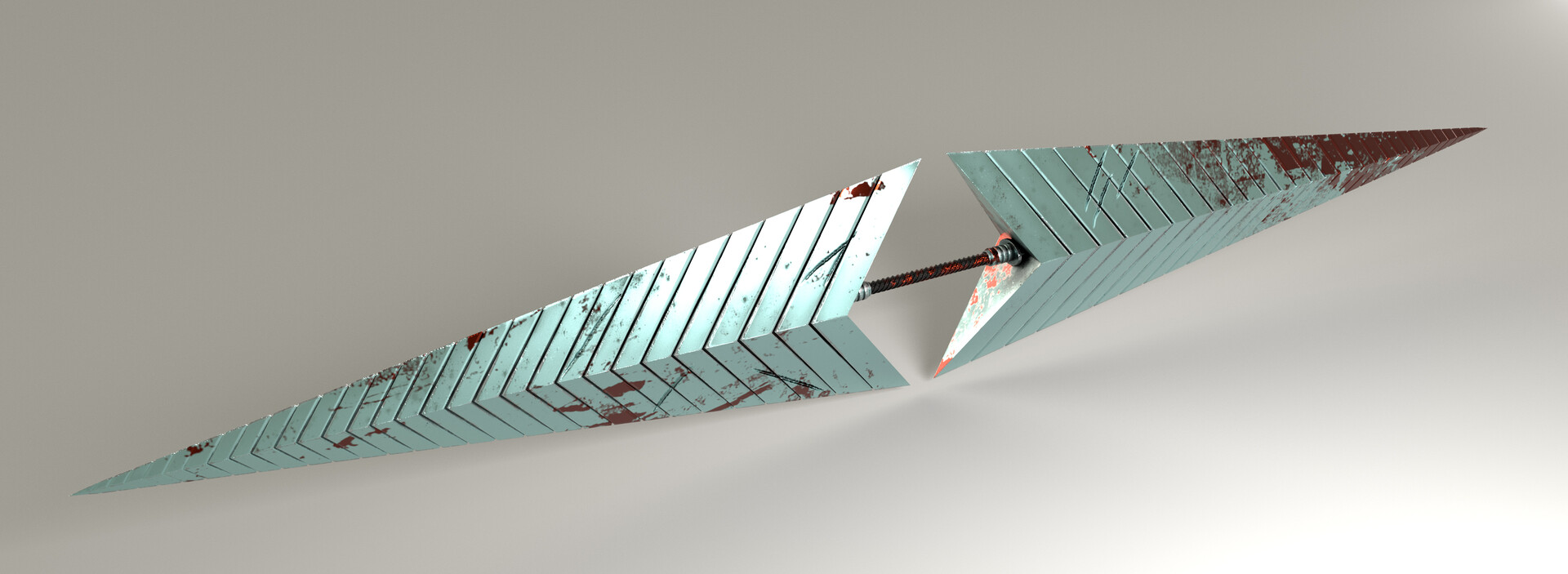
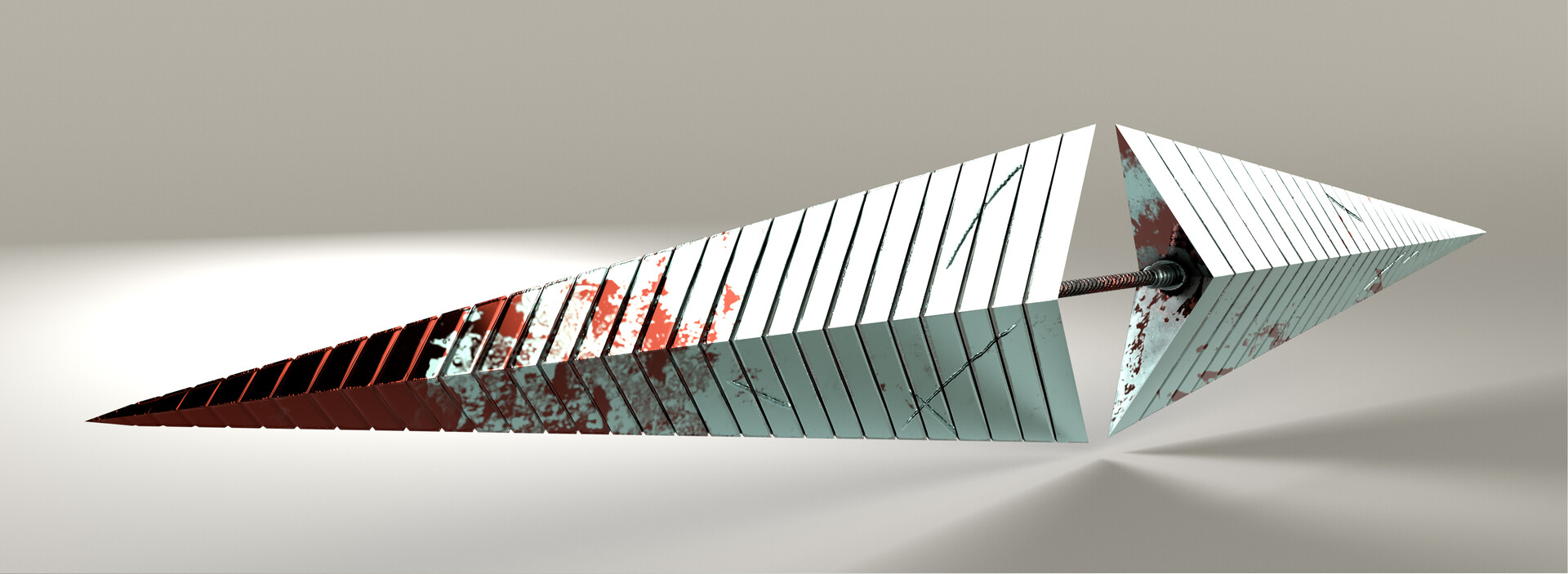
SPLIT · halves separate at the will of the wielder, forming twin shortswords or, at full extension, sacred whips of seven meters.
Inscribed in the Registry of the High Council under Custodia Perpetua. Reverts to the Order upon the wielder's [REDACTED].
A two-handed greatsword whose blade parts cleanly into two matching halves at the will of the wielder. Each half retains balance about its own midpoint, allowing the weapon to be carried as a single longsword, twin shortswords, or (at full extension) twin lashes of seven meters' reach. The steel itself is ordinary top-grade smithwork; what is sacrosanct about the blade is the arts Germain works into it, not the metal.
At the base of the blade sits a small crystal lens. When the dorsal switch is engaged, the lens releases stored lightning along the blade for a handful of seconds.
Originally wielded by Paladin [REDACTED], leader of squadron [REDACTED], Manus Dei Charlemagne. The forge mark predates the founding of the Order. The weapon was issued to Paladin #3113 after initiation and has been with him since. One behavior is on record and has never been explained to anyone's satisfaction: the blade does not part for every hand. Attempts to reissue it after INVECO-002-V all failed, and the older Registry files record the same refusals in Charlemagne's day. The only pattern ever found is will. The blade opens for wielders of unbending resolve, and for everyone else it stays shut. The older files stop just short of calling that judgment, or memory. This file takes no position, and notes only the practical consequence: the choosing decides who can use the weapon effectively, and nothing else. In an accepted hand, Durandal is exactly the weapon described in this file. In any other, it is a very heavy sword.
The blade parts at its midline, and each half extends toward a full seven meters of articulated, segmented reach, carried as twin lashes of steel. A successful catch wraps a limb or a weapon and holds it, and a man who tears himself free against that edge pays for it in his own flesh. The mode's costs are structural and honest: each extended half carries half the blade's mass and half its impact, the reach is slow and telegraphed next to a sword's swing, and controlling seven meters of moving steel from each hand demands his full strength and his full attention. Fine work is impossible. This is a tool for holding, sweeping, and denying ground, not for fencing, and when it carries his anointing, the burn travels down the whole length of it.
Pressing the dorsal switch on either grip discharges stored lightning from the pommel lens along the blades. The steel stays live for a handful of seconds, long enough for an exchange or two: anything the edge or the flat touches takes the shock, muscles seize, grips fail, and the dead lock up outright for a moment. Each press spends part of a reserve that does not refill. The lens was charged in the Order's forges, by a process Germain never witnessed and cannot name, and no facility open to him today can restore it; the charge also bleeds down slowly on its own, used or not. He counts the remaining discharges in single digits, and he treats each one as already spent from the moment he decides to use it.
The physical weapon is demanding but not exotic to keep. The split blade runs on a central articulation and a paired locking mechanism that must be cleaned of grit and re-oiled after any deployment, because a single seized hinge will prevent the blade from parting cleanly and can jam it half open. The two grips carry their own tension fittings that Germain checks by hand before every operation. The steel is ordinary high-grade steel and can be honed and repaired by any competent smith, so the bladework alone is well within field capability. What makes the blade sacrosanct is not the metal but the holy arts Germain works into it.
The complication is the crystal lens set into the pommel. It holds a finite reserve of stored discharge, and it was only ever recharged inside the old Order's forges, using equipment and personnel Germain no longer has any access to. Now that he is cut off from them, that reserve cannot be replenished. Every discharge spends part of a supply that does not come back, and the charge also bleeds down slowly on its own over time whether he uses it or not. He treats the lens as a dwindling resource, to be spent only when it genuinely matters, and he expects a day when it will simply be inert.
If the lens or the articulation is damaged in the field, he cannot repair either himself. The weapon reverts to a plain, if unusually heavy, greatsword until he can reach a facility capable of the work, and no such facility is guaranteed to exist for him anymore.